
Set global Width, Mid/Side gain, balance and rotation, or select one fixed band for its own image controls.
Stereo image / Free early releaseStereofy.
Stereofy.
Find the space.
A focused center. A wider scene. Four-band width, original mono-to-stereo generation and real views of what the signal is doing.
v0.1.0 · Windows x64VST3 + StandaloneFree for personal & commercial audio
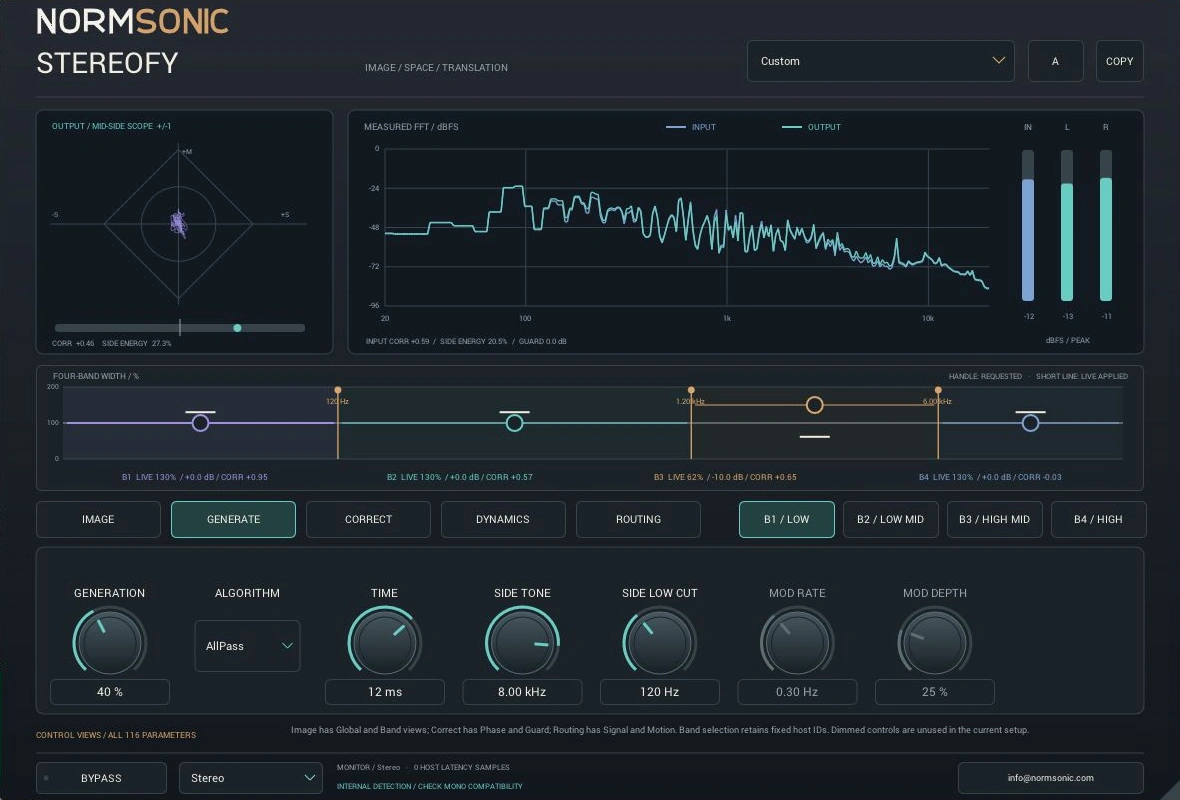
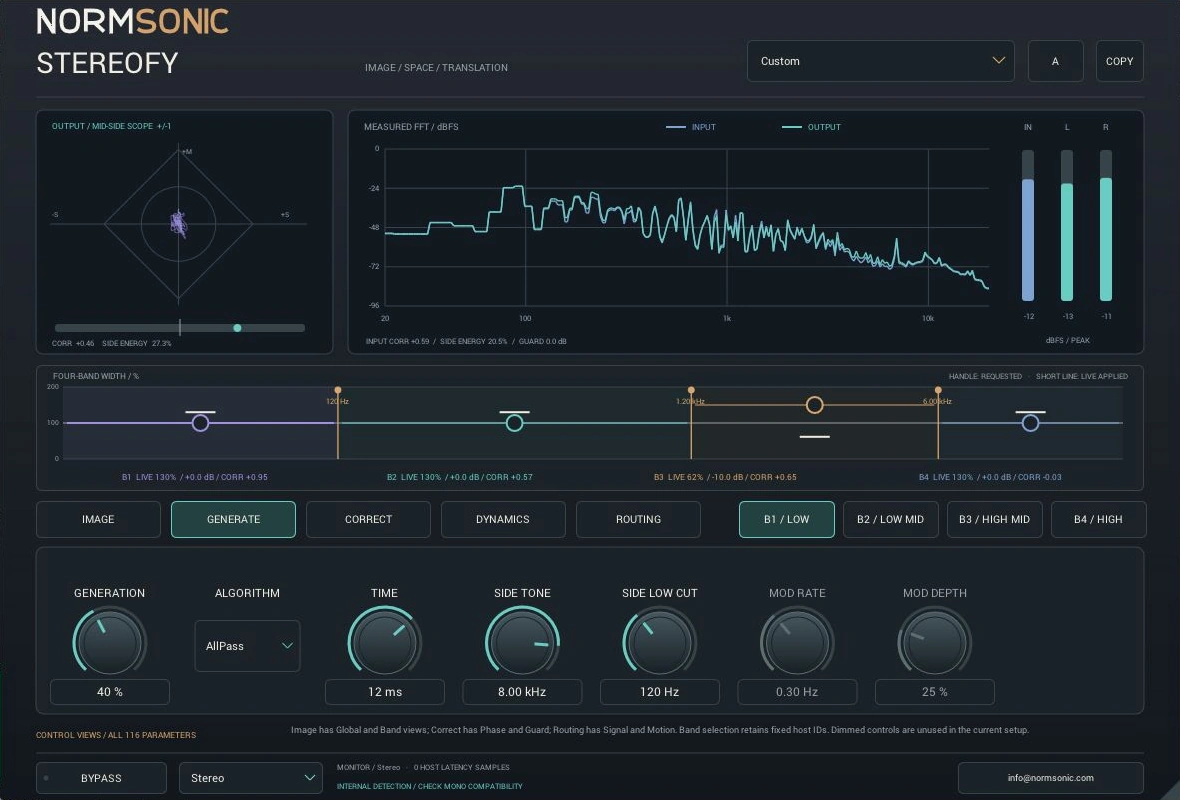
Actual vectorscope, correlation and FFT displays show measured signal. No illustrative idle waveforms are generated.
4 fixed bands · 116 automatable parameters · 32 complete factory recipes
Four-band image
Independent width, Mid/Side balance and dynamics
Five generators
Side Delay, All-pass, Micro Pitch, Spectral and Chorus
Real signal views
Vectorscope, valid correlation and measured I/O spectra
Explicit routing
Correction, mono monitoring and genuine auxiliary detection
5 original algorithmsGenerated Side from the original Mid
116 controls44 globals + 18 fields per fixed band
External sidechainReal optional auxiliary detection
Zero host latencyCausal effect delays are separate
Width. Movement. Compatibility.A stereo scene.
A stereo scene.
A center that matters.
Explore five original generation algorithms and the band, dynamics and routing views. These are behavioural digital designs, without a commercial hardware clone claim.
Selected view
All-pass
Original all-pass diffusion creates a different phase relationship in the generated Side.
Keep the lower center focused with the generator low cut, then blend the amount into a vocal or instrument.
The source. The scene.Hear the space.
Hear the space.
Check the center.
Switch OFF/ON at the same position. Change recipes during playback; the current pair keeps playing while the next one loads. Stereo headphones or speakers reveal generated Side.
Compare the complete 2:50 song and active individual performances, rendered by the actual STEREOFY engine. Every example includes its routing and processing settings.
Loading aligned musical examples…
Image / Generate / Correct / Dynamics / RoutingOpen the image.
Image Generate Correct Dynamics Routing Real feedback Four complementary bands Mono is a decision
Open the image.
Understand the signal.
Five clear control families expose 116 stable parameters through meaningful global and selected-band views.
Create Side from original Mid with five original algorithms. Time, modulation and detune controls dim when the selected algorithm does not use them.
Apply independent causal channel delay or all-pass phase correction. Inspect mono and correlation rather than assuming every change improves compatibility.
Use band-limited Mid, Side, Stereo or External detection to narrow or widen Side above threshold, bounded by Range.
Choose explicit speaker stereo, mono, Mid/Side encode/decode, channel monitoring, swap and polarity controls.
Vectorscope samples are actual output Mid/Side. Correlation is invalid at silence; Side energy is a measured ratio. The FFT is distinct from width controls.
Fourth-order residual low-pass differences overlap. Neutral band settings reconstruct identity; this is not a brickwall or linear-phase crossover.
Pure Side generation alone retains Mid in a neutral path. Rotation, delays, Mid gain, balance and routing can change mono; monitor the actual result.
Read the complete signal and control guide. The claimed host latency is zero; chosen causal correction and generation delays remain part of the effect.
STEREOFY / Your next sessionFind the width.
Find the width.
Keep the focus.
Install the Windows build.
Extract the ZIP and keep the complete STEREOFY.vst3 bundle together. The tested user-folder destination is %LOCALAPPDATA%\Programs\Common\VST3; add it to REAPER's VST paths and rescan.
Contact NORMSONIC with your host, Windows version and issue.
Where should I start?
Choose a restrained recipe, compare Stereo and Mono, and leave useful headroom. A mono source needs generated Side before ordinary Width can widen it.
Does generated stereo survive mono playback?
Generated opposite Side alone retains the original Mid when all other Mid-affecting controls are neutral. Other processing can change mono, so compare the actual result.
Why does correlation become invalid at silence?
Correlation needs signal energy. Silence is shown neutrally, not as a perfect or failed stereo image.
Is it a hardware stereo enhancer clone?
No. The algorithms, routing and dynamics are original behavioural digital designs.
Free early release / 0.1.0Make room.
Make room.
Keep the music.
Verified on Windows: 1,076 native DSP checks, 7,291 VST3 SDK checks and pluginval level 5. Actual REAPER renders match the same engine within half a 24-bit PCM step; all 116 parameters were automated. Zero host PDC. These checks describe the tested setup, not every host or system.
Windows x64
Compiled VST3 plugin and Standalone application. Free Binary Use License; the publisher's own source stays private.
1.21 MiB · Windows x64 · version 0.1.0
macOS
No Mac binary is built, tested or available. This release is Windows only.