
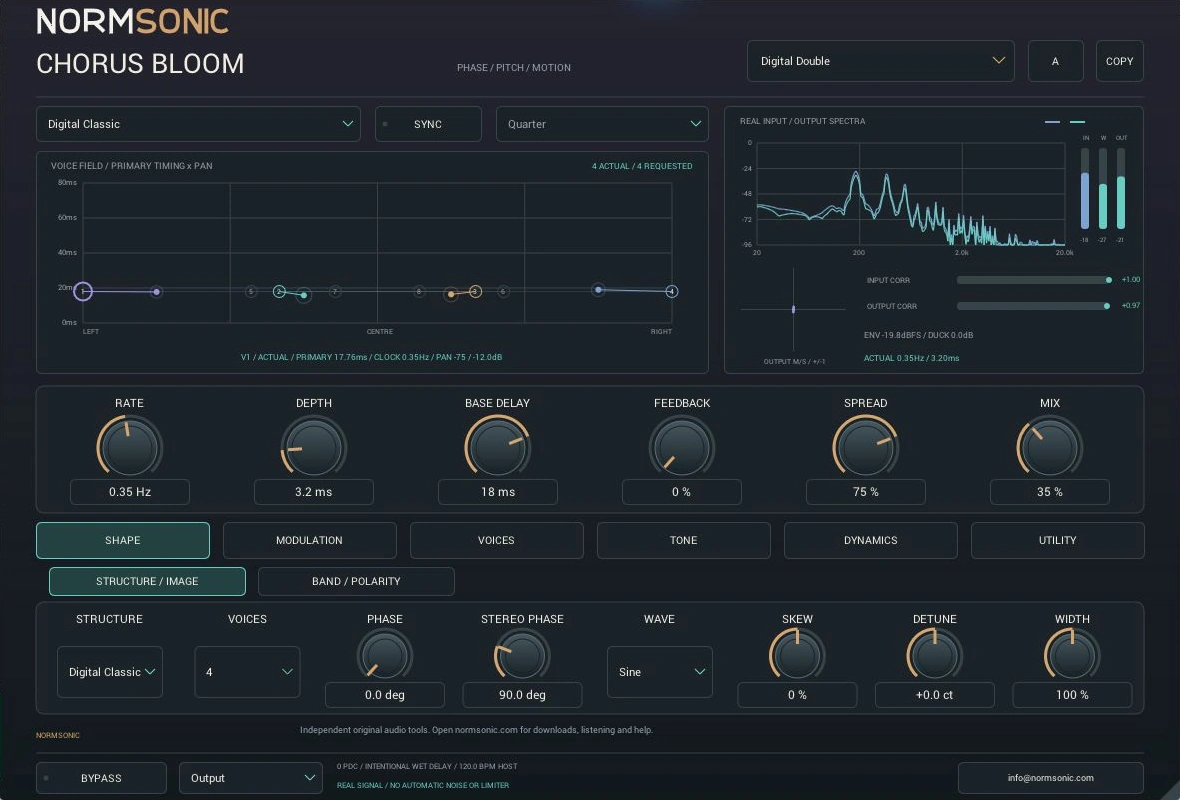
Choose the structure, requested voice count, common phase and stereo phase. A second view handles selected bands, ordered splits and polarity.
Chorus / Pitch / Motion — Free early releaseChorus Bloom.
Chorus Bloom.
Let the voices open.
A little double. A wider ensemble. A pitch field that moves around the performance. Twelve original structures with independent voices and a clear view of the sound.
v0.1.0Windows x64VST3 + Standalone
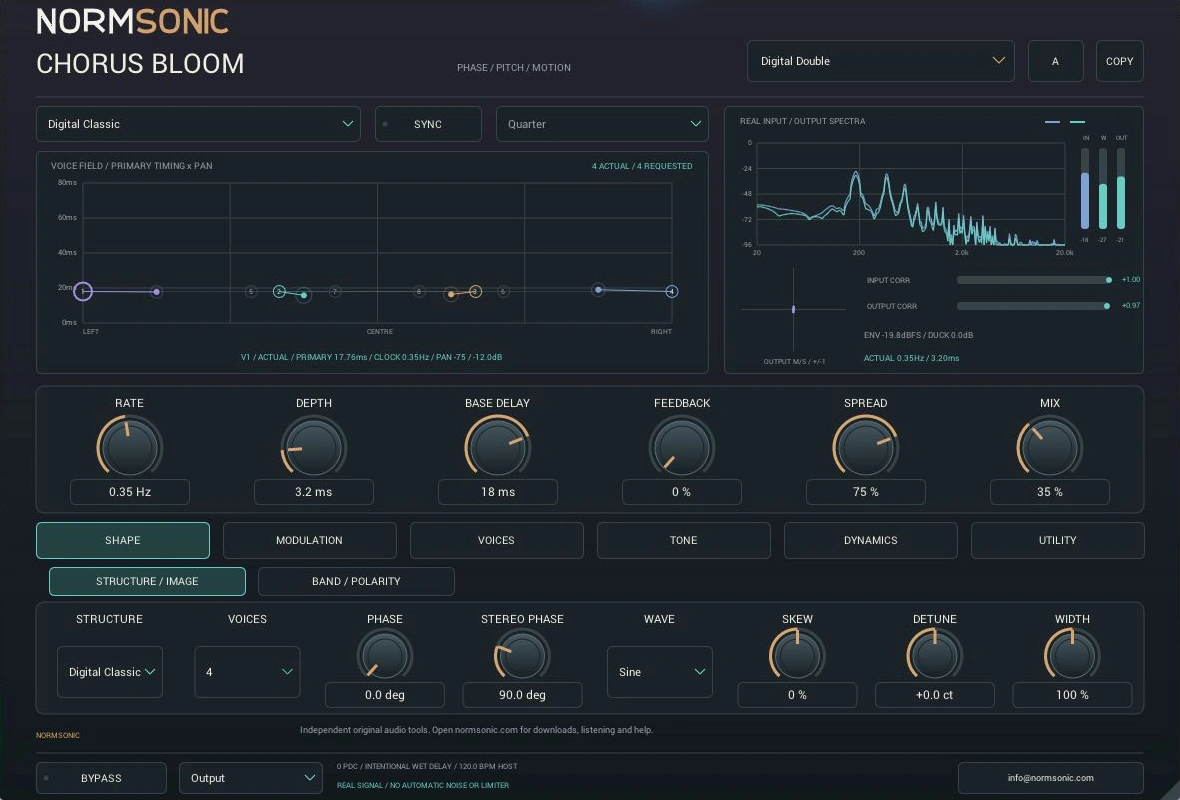
Hollow voice handles are requested timing and pan guides. Solid dots, FFT, scope and detector readings come from the actual engine.
12 original structures
Classic, stereo, ensemble, true micro-pitch and creative diffusion
8 stable voice slots
Independent timing, rate, phase, depth, detune, pan and level
128 controls / 40 recipes
Discoverable views, physical units and complete A/B banks
0 host PDC
Intentional wet-delay timing; no hidden loudness match or limiter
Twelve ways to bloomGive the note
Give the note
some company.
Original digital and analog-inspired behaviours. The family names describe their sound; they do not promise exact branded hardware replicas.
Selected structure
Digital Classic
Clean interpolated delay voices, shaped by rate, depth and a carefully blended return.
Start with two voices and modest Depth; compare Mix before adding feedback.
A performance. Twelve returns.Keep the phrase.
Keep the phrase.
Change the movement.
Switch OFF/ON at the same position. Choose another structure during playback: the current pair continues while the next one loads.
The Diffused comparison uses Diffusion 100% for the full all-pass phase character. Its gallery shows this modified Diffused Halo setting as Custom. The unchanged factory preset can be subtler; partially blended stages can reduce the wet level.
Recorded active phrases and the complete 2:50 song, processed by the actual CHORUS BLOOM engine. OFF/ON stays aligned; every card includes settings and source credits.
Loading recorded musical comparisons…
Six primary controls / Six families of viewsOpen the field.
Open the field.
Keep control.
Rate, Depth, Base Delay, Feedback, Spread and Mix stay visible. All 128 stable parameters are available through labelled views; each voice keeps its own eight controls.
Free rate or real host-synchronized periods; waveform, skew, intentional drift and detector-driven rate/depth.
Select one of eight stable slots. Enabled, Delay Offset, Rate Ratio, Phase Offset, Depth Scale, Detune Offset, Pan and Level stay individually automatable.
Shape feedback filtering, crossfeed and polarity separately from wet filtering, tone, explicit analog colour/noise and diffusion.
Choose real Peak, RMS or External detection and set the envelope. A separate wet-duck view preserves the source while controlling the return.
Input/output trims, routing, explicit monitors, actual display controls and DC removal. No automatic noise, hidden limiter or gain matching.
CHORUS BLOOM / Your next sessionFind the width.
Find the width.
Keep the centre.
Install the Windows build.
Extract the ZIP and keep the complete CHORUS BLOOM.vst3 bundle together. The user-folder destination is %LOCALAPPDATA%\Programs\Common\VST3; add it to REAPER's VST paths and rescan.
Contact NORMSONIC with your host, Windows version and issue.
Why do some voices appear inactive?
The requested count and each Enabled switch determine participating slots. Tri Chorus caps at three; Vibrato uses one. Inactive slots retain their saved values and automation IDs.
Is Micro Pitch just another chorus preset?
It is an original deterministic dual-head pitch-delay structure. Signed global and per-voice cents set detune; oscillator Rate and Depth do not drive that pitch ramp.
Does zero PDC mean no audible delay?
No. The wet return deliberately uses delay for the effect. Host compensation is zero; neutral Mix 0 and settled bypass preserve raw main input.
How should I check mono?
Watch real output correlation, then use the explicit Mono monitor. Lower Mix, Spread or Width when the stereo return competes with the source; these controls do not guarantee compatibility for every signal.
Free early release / 0.1.0Let it bloom.
Let it bloom.
Keep the performance.
Windows 0.1.0 passed 788 native DSP checks, 8,202 actual VST3 SDK checks and pluginval level 5. In tested REAPER on Windows, all 128 product parameters, saved banks and active automation were verified; twelve model renders matched the same engine within half a PCM24 step. These checks describe the tested release, not every DAW or system.
Windows x64
Compiled VST3 plugin and Standalone application. Free for personal and commercial audio; the publisher's own source stays private.
Windows x64 · VST3 + Standalone · 1.22 MiB ZIP
macOS
No Mac binary is built, tested or available. This release is Windows only.